
Return to The DaSyTalks Podcast page.
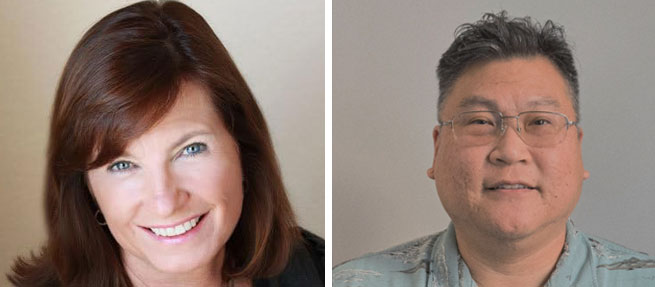
The Episode’s Guests: Tracy Benson, Ed.D. of the Waters Center and Luke Kusumoto, MSW, the State of Hawaii’s Early Intervention Section Child Find Supervisor and Family Engagement Specialist.
In this episode of DaSy Talks, hosts Jenna Nguyen and Howard Morrison sit down with Tracy Benson of the Waters Center for Systems Thinking and Luke Kusumoto from Hawaii’s Department of Health. Together, they explore how systems thinking, and its 14 “habits”, can transform the way state teams use data to improve early childhood IDEA programs. Tracy breaks down systems thinking as a way of understanding relationships within complex systems, while Luke shares how Hawaii’s interagency team applied these habits during a 18-month long cohort facilitated by DaSy, ECTA, and the Waters Center. Their work focused on strengthening child find efforts across early intervention, preschool special education, and home visiting programs.
The conversation takes listeners inside Hawaii’s process of bringing together three agencies, aligning data, and building shared language and trust. Luke describes how activities like the iceberg exercise helped the team uncover assumptions, surface challenges below the “waterline,” and identify gaps in how children and families move through their system. By comparing data across agencies, like referral patterns, socioeconomic factors, and eligibility criteria, the team began shifting from “apples to oranges” comparisons to a coordinated, systems-level view of child find.
Tracy and Luke also reflect on the mindset shifts needed for real systems change. They discuss the importance of discomfort, creative tension, and neuroplasticity—illustrated through simple hand-folding and arm-crossing exercises that reveal how hard it can be to break old patterns. Their message to other states is clear: trust the process, practice the habits of a systems thinker across all parts of your work, and look at your system through the eyes of children and families. The episode highlights how meaningful collaboration, shared purpose, and intentional data use can lead to increased access to early childhood services.
Download the transcript.
Related Resources
- DaSy Data System Framework
- Critical Questions
- Look! Think! Act!
- Data Leadership Competencies
- Data Culture Toolkit
- Data Inquiry Cycle
- Waters Center for Systems Thinking
- Habits of a Systems Thinker
- Blog: Creating Positive Change Through a Culture of Data Use and Systems Thinking
- Create Positive Change Through Data Culture and Systems Thinking
About Our Guest and Hosts

Tracy Benson, Ed.D. of the Waters Center is a leader, author and innovator in the fields of systems thinking and organizational learning. Tracy brings extensive practitioner experience to her board service. As an educator, she has taught at elementary and secondary levels and has been a school principal and district level instructional coach and evaluator. In addition to K-12 experience, Tracy has served as an adjunct professor in both undergraduate and graduate university programs for teachers and administrators. She has been a contributing author to several books and articles, most recently authoring The Systems Thinking Facilitator’s Toolkit.

Luke Kusumoto, MSW, is the State of Hawaii’s Early Intervention Section Child Find Supervisor and Family Engagement Specialist. He has devoted his entire 20+ year career to early intervention, working in both public and private sector roles, spanning social work/care coordination, quality assurance, and administration. He has been a proud resident of Hawai‘i his entire life, loves the outdoors, and is happily married with two girls who are now in college and 12 cats.

Howard Morrison is a DaSy Technical Assistance State Liaison who specializes in early childhood education on a variety of topics, including interagency data integration and data use, data governance, data sharing agreements, school readiness, transitions, public–private partnerships, community engagement, and systems and relationship building in state systems.

Jenna Nguyen is a technical assistance specialist for The DaSy Center. With over 10 years of experience across the early childhood and special education systems, she brings a passion to empowering families, cultivating authentic connections, and integrating systems thinking and data to ensure that children and families can access the quality services and supports they need to thrive.