The System Design and Development subcomponent addresses the characteristics of the functional and technical requirements for database applications, and the development and implementation of applications based on those requirements. This subcomponent includes the process of defining the database structure, user interface, system standards and components, and the data elements. State staff involvement, input, and review throughout the entire process are hallmarks of a high-quality Part C and Part B 619 data system.
The purpose of the System Design and Development subcomponent is to assist states in creating and supporting database applications based on the Part C and Part B 619 program requirements consistent with the purpose and vision. System design and development is the means by which the operational needs of the program staff and other users are translated into a functional and technical infrastructure that will meet those needs. This subcomponent supports the development of new database applications as well as major enhancements to existing systems.
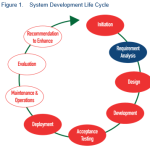
This subcomponent was developed around the phases and processes of a standard System Development Life Cycle (SDLC), which includes (1) system initiation; (2) system requirements analysis; (3) system design; (4) system development; (5) system acceptance; and (6) system deployment. This subcomponent should begin once a high-level plan is approved for a new database application or enhancement and ends when the application or enhancement is deployed. Ongoing management to support the application is addressed in the Data Governance and Management subcomponent, and the evaluation of the application to determine needed enhancements is addressed in the Sustainability subcomponent. Designing and developing a database application involves numerous technical requirements and processes usually performed by the information technology (IT) team and not the Part C and Part B 619 staff. Although the technical activities conducted by the IT team are not addressed within this subcomponent, Part C and Part B 619 staff should collaborate with them to ensure the application functions as expected.
This subcomponent consists of three sections, each of which addresses two phases of the SDLC. The first section, Initiation and Requirements Analysis, addresses the first two phases of the life cycle: initiation of a new database application or enhancement, and system requirements analysis. The purpose of requirements analysis is to obtain a thorough and detailed understanding of the “business” or program needs and to break those into discrete requirements that provide the foundation this work. These requirements must then be clearly defined, reviewed, and agreed upon by the state Part C and Part B 619 staff. Sufficient time and resources should be allocated during system requirements analysis to bring stakeholders and their interests into the process. Subject-matter experts in Part C and Part B 619 must also be actively involved in defining business requirements through an iterative process.
This first section also addresses critical data elements and functions that should be included in a high-quality Part C or Part B 619 database application. A fundamental purpose of the framework is to help states develop more robust and comprehensive database applications, and such applications include the suggested data elements and functions. Although many state database applications do not have all the suggested data elements and functions, the purpose of the framework is to help states move toward more effective systems. It is important to look at emerging programmatic and technical issues when developing system functionality, e.g., incorporating new data elements, designing for access through mobile devices, electronic signature capability, parent portals, and predictive analytics.
The second section, Design and Development, addresses the technical aspects of the system design and development work. Part C and Part B 619 staff may not be directly involved in this technical work. The state should, however, have a process in place for Part C and Part B 619 state staff to work and communicate with the IT team, regularly providing input, feedback, and approval when necessary.
The third section, Acceptance and Deployment, addresses the fifth and sixth phases of the SDLC. Successful acceptance testing is the final opportunity to establish that the database application performs as expected in environments that closely simulate those which will be used after deployment. During acceptance testing, end users thoroughly test the application as if it were fully implemented. This section also includes updating supporting documentation and reference materials. Deployment refers to the launch of the new database application or enhancement.
Section 1: Initiation and Requirements Analysis
Quality Indicator SD1
Part C/619 state staff are actively involved in initiating the development of the new database application or enhancement, including business requirements, process models, and data models.
about SD1 Elements of Quality
SD1 – Elements of Quality
SD1a
Input is provided to determine project team roles and responsibilities and commit staff to the development of the database application/enhancement.
SD1b
Input is provided on how the new system/enhancement will be developed (i.e., vendor/contractor, in-house, commercially available product).
SD1c
Input is provided into the plan and the schedule for the system requirements analysis and other remaining system design/development phases.
SD1d
A plan for the application/enhancement is reviewed to ensure that it meets Part C/619 goals and needs.
SD1e
The following are developed with input and ongoing review to ensure they reflect an accurate understanding of the Part C/619 program, processes, and language:
Stakeholder input is gathered for business requirements, process models, and data models.
SD1g
A clear process is used for the approval of the final business requirements.
Quality Indicator SD2
The system requirements analysis results in documented requirements for the new database application/enhancement that accurately describe what the new application/enhancement must do.
about SD2 Elements of Quality
SD2 – Elements of Quality
SD2a
Functions of the database application/enhancement are fully specified and expressed in the language of the Part C/619 program.
SD2b
Business requirements are drafted, prioritized, and then identified as either in or out of scope.
SD2c
The system requirements address technical requirements that operate in the background (e.g., encryption, system performance and load, data archiving, and audits and controls).
SD2d
Process models and workflow diagrams visually depict major processes such as eligibility determination and IFSP/IEP and subfunctions such as IFSP/IEP development, review, etc.
A data model identifies the data elements, the attributes that define those data, and the relationships between the entities (database tables).
SD2g
An initial data dictionary is produced that defines the data elements, their attributes, and the logical relationships among the data elements.
SD2h
Criteria are established for running the legacy system in parallel with the new database application and the point at which the legacy system is retired.
Quality Indicator SD3
The Part C/619 state database application has the capacity to support accountability, program improvement, and program operations, and should contain the following data elements and functions.
about SD3 Elements of Quality
SD3 – Elements of Quality
SD3a
Includes, but is not limited to, the following types of data:
Reason eligible (e.g., developmental delay, visual impairment, established condition or disability)
Reason for delay of eligibility determination
Descriptive information on nature of delays/disabilities (e.g., International Classification of Diseases codes (ICD-9), diagnosed conditions, areas of delay)
IFSP/IEP
Date
Type (e.g., initial, annual)
Services (planned and received)
For each planned service:
Type
Start date
End date
Frequency
Intensity (e.g., minutes/session)
Method
Setting
For services received:
Types
Dates
Minutes
Providers
For Part C: Reason for delay of initiation of service(s)
Attendance in any center-based program (e.g., child care, preschool)
Enrolled in public insurance, e.g., Medicaid, CHIP
Type (e.g., school district, other public provider, private)
Size of program/district in terms of number of children (e.g., total # of children
≤ 5 years old)
Size of program/district in terms of number of children ≤ 5 years old who receive IDEA services
Size of program/district in terms of staff (e.g., number of full-time equivalent [FTE] serving children ≤ 5 years old receiving IDEA services)
Inclusion opportunities (i.e., does entity provide IDEA services in settings where children without disabilities are receiving early care and education?)
Local determination
Financial data
Total funds budgeted for the Part C or 619 program
Total funds expended for the Part C or 619 program
Funds budgeted by revenue source (e.g., federal Part C/ Part B, state, private insurance, public insurance)
Funds expended by revenue source (e.g., federal Part C/ Part B, state, private insurance, public insurance)
SD3b
Has the capacity to share and transfer child records when child moves from one Part C/619 local program to another in the state.
SD3c
Has built-in data validation and edit-check routines (e.g., format checks, field validation restrictions, logical consistency checks).
SD3d
Has established reports to assess data quality (e.g., error reports, outliers, missing data).
SD3e
Has controls in place so end users access data consistent with federal, state, and local privacy requirements, including requiring strong passwords; limits on the length of access (e.g., session timeouts, use of different user types and role-based permissions).
SD3f
Has embedded supports and training materials for end users (e.g., mouse over definitions, support documents, practice scenarios, practice site, audiovisual tutorials).
SD3g
Directly or through a related application, has reporting and analytic tools that:
Provide access to raw and aggregate data in reasonable time
Allow users to disaggregate the data, e.g., by type of disability, age at date of first service, etc.
For transactional systems: Provides automated functions that support program practices for end users (e.g., date tickler or calendar reminders of critical dates such as deadlines for IFSP/IEP reviews and transition conferences).
SD3i
Has provisions that allow the state to comply with federal, state, and local data privacy and security requirements, including those that address the following:
Data transmission
Data storage
Data encryption
Data back-up and recovery
Data archival and destruction
SD3j
Allows for selected administrative modifications within the database application with little or no reliance on the IT team, such as adjusting user permissions and adding support documents.
SD3k
Has the capacity to link various child-level data elements, including child outcomes.
SD3l
Has the capacity to link child-level data with service provider/teacher data.
SD3m
Has the capacity to link child-level data with program/school/classroom data.
SD3n
Has the capacity to link service provider/teacher data with program/school/classroom data.
SD3o
Has the capacity to link family survey/outcomes data with other child-level data, including child outcomes.
SD3p
For transactional systems: Can track entries/changes made by end users to data in the database, and the user who made them.
SD3q
Has interoperability that allows for Part C or 619 data to be linked with other statewide longitudinal and early childhood data systems.
Section 2: Design and Development
Quality Indicator SD4
Part C/619 state staff work together with the IT team to translate requirements into the design, build, and testing of the new database application/enhancement.
about SD4 Elements of Quality
SD4 – Elements of Quality
SD4a
Aspects of the applications’ infrastructure (e.g., hardware and software, naming conventions, importing legacy data) are jointly decided.
SD4b
The database application requirements are jointly refined with consideration of the scope.
SD4c
Mock-ups of modules, reports, and other functions are jointly reviewed, refined, and approved.
SD4d
The data dictionary is jointly developed and continually refined throughout the process.
SD4e
Modules are jointly developed and reviewed before user acceptance testing.
SD4f
Adequate system performance is jointly designed for anticipated peak usage.
SD4g
Legacy data and new data are accurately processed together per the requirements.
Section 3: Acceptance and Deployment
Quality Indicator SD5
Part C/619 state staff prepare for, communicate about, and conduct user acceptance testing to ensure the new database application/enhancement functions properly before deployment.
about SD5 Elements of Quality
SD5 – Elements of Quality
SD5a
Representative end users (e.g., based on user types, permissions) are selected for user acceptance testing.
SD5b
A user acceptance testing plan, including a schedule and expected testing environment, is created in collaboration with the IT team.
SD5c
Testing materials (e.g., test data, sample cases) and feedback mechanisms are prepared for user acceptance testing.
SD5d
User acceptance testing findings and other forms of user feedback are communicated to the IT team.
SD5e
User acceptance testing plans are adjusted as needed in collaboration with the IT team
SD5f
User acceptance testing is repeated as necessary until the system functions properly.
Quality Indicator SD6
Part C/619 state staff participate in creating, reviewing, and revising materials to support the implementation of the database application/enhancement.
about SD6 Elements of Quality
SD6 – Elements of Quality
SD6a
User support and technical materials (e.g., technical documentation, user manuals, online tutorials, webinars) are created and updated, as necessary.
SD6b
Materials are updated based on users’ review and feedback.
SD6c
Changes to the materials are communicated to help desk support.
SD6d
Written documentation delineating administrator/staff roles associated with the application is developed to guide the transfer of knowledge about the application to new Part C/619 state staff, IT staff, and vendors.
Quality Indicator SD7
Part C/619 state staff communicate and work with the IT team to deploy the new database application/enhancement.
about SD7 Elements of Quality
SD7 – Elements of Quality
SD7a
A deployment plan, including guidelines for transition to the new data application/enhancement, schedule for running legacy and new system in parallel, roles and responsibilities, and contingency steps, is created in collaboration with the IT team.
SD7b
The deployment plan is communicated to all necessary parties, including state and local staff.
SD7c
End user support (e.g., training, release notes) is provided for the new application/enhancement.
SD7d
The new database application is deployed, or new enhancement released, in collaboration with IT.
SD7e
The responsibility for the new database application/enhancement is transitioned to the state agency.
Resources Related to System Design and Development
This is a five step guide to conducting a business requirements analysis.
Published by: MindTools.com
Business Requirements Analysis: Clearly Agreeing What You’re Going to Deliver
This DaSy report provides an overview of process modeling and data modeling and explains the value of each in the development or major enhancement of ...
This DaSy toolkit provides resources to support decision-making for states that wish to develop or enhance an IDEA Part C data system. The toolkit details ...
This DaSy brief follows Key Considerations for Initiating and Planning a New Data System or Major Data System Enhancement and provides Part C/619 staff with ...
This electronic book provides guidance to increase project management competence and foster sustained success for projects.
Published by: New York State Office for Technology
Project Management ...
To provide the best experiences, we use technologies like cookies to store and/or access device information. Consenting to these technologies will allow us to process data such as browsing behavior or unique IDs on this site. Not consenting or withdrawing consent, may adversely affect certain features and functions.
Functional
Always active
The technical storage or access is strictly necessary for the legitimate purpose of enabling the use of a specific service explicitly requested by the subscriber or user, or for the sole purpose of carrying out the transmission of a communication over an electronic communications network.
Preferences
The technical storage or access is necessary for the legitimate purpose of storing preferences that are not requested by the subscriber or user.
Statistics
The technical storage or access that is used exclusively for statistical purposes.The technical storage or access that is used exclusively for anonymous statistical purposes. Without a subpoena, voluntary compliance on the part of your Internet Service Provider, or additional records from a third party, information stored or retrieved for this purpose alone cannot usually be used to identify you.
Marketing
The technical storage or access is required to create user profiles to send advertising, or to track the user on a website or across several websites for similar marketing purposes.


 Key Considerations for Initiating and Planning a New Data System or Data System EnhancementThis DaSy brief is an updated version of the 2015 document and presents key considerations in the form of questions that can be used to ...Read more
 Part C Data System FunctionsThis DaSy Part C Data System Functions resource contains a list of Part C data system functions designed to assist in developing and enhancing ...Read more
 Business Requirements Analysis: Clearly Agreeing What You’re Going to DeliverThis is a five step guide to conducting a business requirements analysis. Published by: MindTools.com Business Requirements Analysis: Clearly Agreeing What You’re Going to DeliverRead more
 Building a Better Data System: What Are Process and Data Models?This DaSy report provides an overview of process modeling and data modeling and explains the value of each in the development or major enhancement of ...Read more
 IFSP Information ToolkitThis DaSy toolkit provides resources to support decision-making for states that wish to develop or enhance an IDEA Part C data system. The toolkit details ...Read more
 Developing and Sharing Your Business Requirements to Build a Better Data SystemThis DaSy brief follows Key Considerations for Initiating and Planning a New Data System or Major Data System Enhancement and provides Part C/619 staff with ...Read more
 Project Management Guidebook: System Development Life CycleThis electronic book provides guidance to increase project management competence and foster sustained success for projects. Published by: New York State Office for Technology Project Management ...Read more