
Newly updated! The Part C Exiting Data Tool is designed to be used by states as they prepare their IDEA 618 exit data for submission via EDPass.
IDEA Part C Exiting Data Check Tool

Newly updated! The Part C Exiting Data Tool is designed to be used by states as they prepare their IDEA 618 exit data for submission via EDPass.

New tools to support States reporting requirements on the correction of findings of noncompliance in the new SPP/APR Indicator C12 beginning with the FFY 2023 SPP/APR.
This letter was jointly developed by offices within the U.S. Department of Health and Human Services and the U.S Department of Education to support increased collaboration between State Early Hearing Detection and Intervention programs and IDEA Part C early intervention programs.

Designed to provide assistance to IDEA Part C Data Managers and other users of the EDFacts Metadata and Process System (EMAPS). This tool offers a way to ensure accuracy of IDEA Part C Child Count and Settings data prior to official submission. The Part C Child Count and Setting Data Tool allows the state to enter their data and have any errors flagged. Corrections can then be made prior to data entry and submission in EMAPS.

This document provides an example memorandum of understanding (MOU) that can used between the State Agency under the Individuals with Disabilities Act (IDEA Part B,619 and Part C) and the State Autism Developmental Disabilities Monitoring Program (State ADDM) funded by the Center for Disease Control. The purpose of the MOU is to share key data about the characteristics of children with autism spectrum disorder (ASD) and other disabilities in communities.
Milestones from the Early Childhood Development Chart are one of many sources of information that can help teams understand how skills align with with Three Child Outcomes states measure for federal reporting purposes. States report outcomes data to the Office of Special Education Programs (OSEP) each year in the State Performance Plan/Annual Performance Report (SPP/APR). […]

This is a resource for Part C and Part B 619 program staff looking to share or link their IDEA Part C to Part B 619 transition notification data. This resource contains both an example use case and a sample template for states and territories to use.
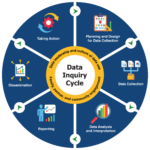
The data inquiry cycle is an iterative sequence of six stages: planning and design for data collection, data collection, data analysis and interpretation, reporting, dissemination, and taking action.
This checklist has been developed by the EHDI Outcomes Committee as a resource for state Part C and EHDI staff to use as they develop Data Sharing Agreements, consistent with the federal requirements under the Individuals with Disabilities Education Act (IDEA) and Family Education Rights and Privacy Act (FERPA).
Do you need help identifying possible gaps in documentation required for OSEP’s differentiated monitoring and support process? This crosswalk is designed to provide an overview of the major themes covered in the Differentiated Monitoring and Support (DMS) Part B/C Data Protocol and where those themes could be addressed when a state chooses to use the DaSy Part C Data Processes Toolkit.